Medically reviewed by Dr. Bouraoui Kotti, Specialist Plastic Surgeon, MD, PhD
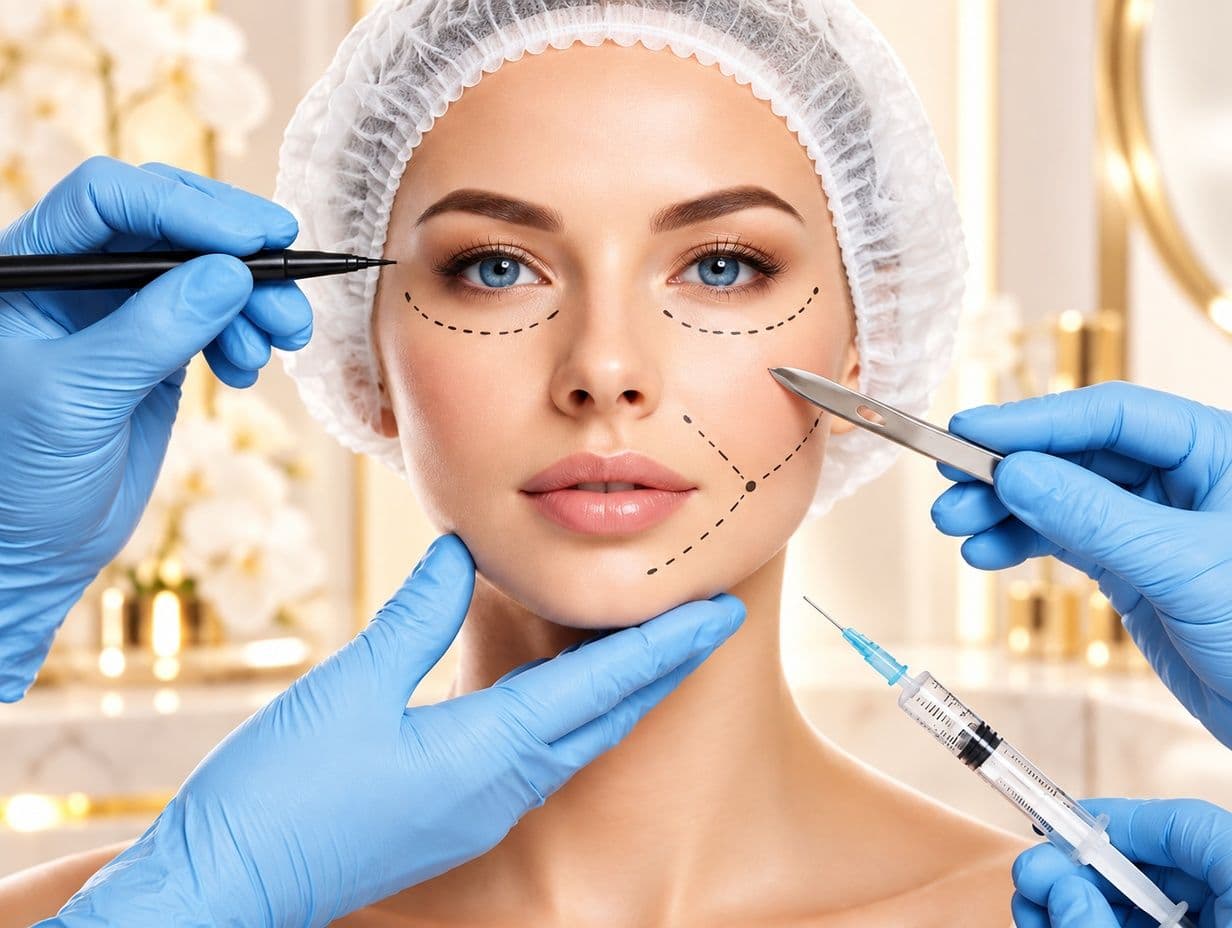
You may notice heavier eyelids, a lower brow position, flatter cheeks, jowls, loose skin around the neck, or a change in the shape or proportion of your nose. Each of these concerns can come from a different part of the facial anatomy, so the right treatment depends on what has changed, your skin quality, your overall health, and the result you want to achieve.
The main types of facial plastic surgery include facelift surgery, neck lift, brow lift, eyelid surgery, midface lift, facial fat grafting, rhinoplasty, and facial contouring procedures.
At Seline Clinic in Jumeirah, Dubai, facial surgery begins with a whole-face assessment. The aim is to understand how the brows, eyelids, cheeks, jawline, neck and facial proportions relate to one another before deciding which procedure is appropriate.
What Does Facial Plastic Surgery Actually Treat?
Facial plastic surgery covers procedures that reshape, restore or rejuvenate structures of the face and neck. Some procedures are performed for cosmetic reasons. Others have reconstructive aims, or combine functional and aesthetic goals.
Ageing affects the face at several levels. Skin gradually loses elasticity, facial fat changes in position and volume, and deeper supporting tissues can descend. Around the lower face this can appear as jowls or a softer jawline. Around the eyes, the visible change can come from eyelid skin, fat, brow position, or more than one of these factors.
Surgery is used to address structural change. A facelift can reposition descended tissue and remove excess skin, while concerns such as pigmentation, sun-related change and fine surface lines are treated through a different skin-focused approach.
A Quick Guide to the Main Procedures
Main concern
Procedure that may be considered
Jowls or lower-face laxity
Facelift
Loose neck skin or visible neck bands
Neck lift
Heavy or descended brows
Brow lift
Excess upper-eyelid skin
Upper blepharoplasty
Under-eye bags or lower-eyelid fullness
Lower blepharoplasty
Descended or flatter cheeks
Midface lift
Facial volume loss
Facial fat grafting
Nose shape or proportion
Rhinoplasty
Chin imbalance
Genioplasty or chin augmentation
This table is a starting point. The same visible concern can have more than one anatomical cause, which is why an examination is needed before a procedure is recommended.
Facelift Surgery: When the Lower Face Has Changed
A facelift is mainly used to treat structural ageing in the lower face. Patients commonly consider surgery when the jawline has lost definition, jowls have developed, or the skin and deeper tissues have started to descend.
Modern facelift surgery addresses the supporting tissues beneath the skin as well as the skin itself. One of the key layers is the superficial musculoaponeurotic system, or SMAS, which is involved in many established facelift techniques.
The surgical approach is chosen according to the anatomy and the degree of tissue descent:
SMAS facelift: repositions and tightens the deeper supporting layer beneath the skin.
Deep plane facelift: mobilises deeper facial tissues so they can be repositioned with less reliance on skin tension.
Limited-incision or mini facelift: a smaller operation for patients with earlier lower-face laxity. Techniques can include approaches such as the MACS lift or S-lift.
Endoscopic techniques: use smaller incisions and camera assistance in appropriate facial areas.
Technique selection depends on the pattern and extent of ageing. Early jowling with good skin quality presents a different surgical problem from advanced lower-face and neck laxity.
Who Usually Considers a Facelift?
Most facelift candidates have visible tissue descent in the cheeks, jawline or lower face and are medically suitable for elective surgery. Smoking, medications, supplements, previous surgery and existing medical conditions all form part of the assessment because they can influence bleeding, healing and anaesthesia.
Age by itself is a poor shortcut. Tissue quality, anatomy and the pattern of ageing usually tell the surgeon more than the number on a passport.
What the Operation and Recovery Can Involve
Facelift surgery can be performed under general anaesthesia or intravenous sedation, depending on the operative plan, patient factors, surgeon preference and facility protocol. Incisions are commonly positioned around the ear and within or close to the hairline, following natural boundaries wherever possible.
Swelling and bruising are most noticeable early in recovery. Some patients have a temporary drain or compression dressing, and sutures can be removed in stages. For many facelift patients, the visible recovery is measured in weeks, while deeper healing continues beyond that point.
Residual swelling settles gradually, and the face continues to refine for several months before the result can be properly assessed.
What a Facelift Can and Cannot Do
A facelift can improve jowls, lower-face laxity and jawline definition. Repositioning descended tissue can also soften some facial folds.
Fine surface lines, uneven pigmentation and sun-related skin changes can remain after surgery and can require separate treatment.
Facelift scars are permanent, although they are positioned within the hairline and around natural ear contours where possible. Haematoma is one of the recognised early complications after facelift surgery. Nerve injury is uncommon but possible. Other risks include infection, wound-healing problems, fluid collection, asymmetry and complications related to anaesthesia or blood clots.
What People Mean by a 'Full Facelift'
The phrase "full facelift" is commonly used to describe a broader surgical plan involving several areas of the face and neck rather than one single standardised operation.
For one patient, this can mean an extended facelift with a neck lift. For another, the plan can also include blepharoplasty, a brow lift or facial fat grafting. The combination is chosen according to the areas that contribute to the overall facial appearance.
Combined surgery involves a longer operation and a more involved recovery. Several areas can be treated in one procedure when this is appropriate, while other patients are better served by a staged plan.
Midface Lift: When the Cheek Is Part of the Problem
The midface can be easy to overlook because the concern is often noticed somewhere else. A patient may focus on deeper smile lines or a hollow beneath the eyes when part of the change is actually coming from the position of the cheek.
As cheek tissue descends, the upper cheek can look flatter and the transition between the lower eyelid and cheek becomes less smooth. A midface lift repositions this tissue and restores support to the area.
Suitability depends on cheek position, tissue descent, skin quality and facial anatomy more than on a specific age.
The operation can be performed through an endoscopic or more traditional approach. It can also be combined with lower blepharoplasty when the lower eyelid and cheek need to be treated as one aesthetic unit. Recovery varies considerably. Bruising and swelling settle first, while the final contour can take months to mature.
Brow Lift: Is the Brow Really the Cause?
Heavy upper eyelids are a good example of why diagnosis matters. For some patients, excess eyelid skin is the main issue. For others, the brow itself has descended. Both can contribute at the same time.
A brow lift repositions descended brows and can create a more open appearance in the upper face. It can also soften some forehead creases. Dynamic expression lines are influenced by muscle activity and can require separate treatment.
Common surgical approaches include:
Endoscopic brow lift: uses small scalp incisions and camera assistance.
Temporal brow lift: focuses mainly on the outer brow.
Coronal or open brow lift: a more extensive traditional approach that can be considered in appropriate cases.
Thread lifting is a non-surgical treatment with a different mechanism, degree of correction and expected duration from surgical brow lifting.
Swelling and bruising are common during early recovery. Patients need a period of social recovery, and strenuous activity is restricted until healing has progressed sufficiently.
Blepharoplasty: Upper Eyelids, Lower Eyelids, or Both?
Blepharoplasty is eyelid surgery and can involve the upper eyelids, lower eyelids, or both, depending on the concern being treated.
Upper blepharoplasty removes or reshapes excess tissue through an incision placed in the natural eyelid crease. Lower blepharoplasty addresses under-eye bags and related contour concerns. In some lower-eyelid cases, the surgeon can use a transconjunctival approach through the inside of the eyelid, avoiding an external skin incision.
When the upper and lower eyelids are treated in one operation, this is called combined upper and lower blepharoplasty.
Bruising, swelling, dryness and temporary irritation are common early effects. The appearance improves as swelling settles, although subtle swelling can take longer to resolve.
Rhinoplasty: Reshaping the Nose in Balance With the Face
Rhinoplasty changes the shape, size or proportions of the nose. Some patients have a feature they have wanted to change for years. Others consider surgery after an injury or because the nose feels out of balance with the rest of the face.
The operation can address the bridge, tip, nostrils, width, projection or overall nasal shape. Cosmetic rhinoplasty can also be planned alongside functional nasal surgery when breathing concerns are present.
Good rhinoplasty planning considers the nose in relation to the rest of the face. The surgeon looks at the chin, forehead, lips, facial width, skin thickness and overall profile. Even a relatively small nasal change can make a noticeable difference to facial balance.
Swelling is expected after rhinoplasty and is most noticeable in the early stages. Much of it settles gradually, while the nose can continue to refine for many months before the final shape is fully appreciated.
Neck Lift and Jawline Contouring
The neck can show a different pattern of ageing from the face. Some patients develop loose skin, while others are more concerned about platysmal bands, fullness beneath the chin, or loss of jawline definition.
A neck lift can tighten loose skin and address platysmal bands. When submental fat is also present, the surgical plan can include liposuction or another contouring technique.
Liposuction works best when there is localised fat and the skin has enough elasticity to retract. In a neck with substantial skin laxity, removing fat alone may not provide enough correction.
Other Facial Contouring Procedures
Facial plastic surgery also includes procedures that focus primarily on proportion and contour rather than ageing changes.
Buccal fat removal: reduces fullness in the lower cheek. Careful patient selection matters because facial volume naturally decreases with age.
Chin surgery: can involve genioplasty or an implant to improve balance between the chin, nose and jawline.
Otoplasty: changes the position or shape of prominent ears.
Surgical Facelift vs Non-Surgical Facial Rejuvenation
Surgical and non-surgical treatments work in different ways.
Surgery physically repositions descended tissue and can remove excess skin. Non-surgical treatments have different roles. Fillers can restore volume in specific areas, while botulinum toxin alters muscle activity. Skin boosters and biostimulators target skin quality or collagen-related change. Energy-based treatments can help with mild laxity, and thread lifts create a more limited and temporary mechanical effect.
Treatment choice should match the anatomical problem. Mild laxity can respond to non-surgical treatment. Established tissue descent generally requires surgery when meaningful structural repositioning is the goal.
How a Surgeon Decides Which Procedure Fits
Patients sometimes arrive with the name of an operation already in mind. Examination can point to a different plan because the visible concern does not always come from the area the patient expects.
A softer jawline can result from jowling, neck laxity, submental fat, a small chin, or a combination of these factors. Heavy upper eyelids can come from eyelid skin, brow descent, or both. A hollow beneath the eye can relate to the eyelid, cheek position, volume loss, or several of these changes together.
The consultation therefore looks at the face as a whole. Skin elasticity and facial volume matter, as do tissue descent, bone structure and medical history. Smoking, medications, weight stability and the amount of recovery time available also influence planning.
The operation should follow the anatomy, not the trend.
Risks and Safety Considerations
Every operation carries risk, including elective surgery performed after careful planning. The exact risks depend on the procedure. Facial surgery can involve bruising, swelling, numbness, bleeding, haematoma, infection, delayed wound healing, asymmetry, scarring, temporary or rarely lasting changes in sensation or muscle movement, and complications related to anaesthesia.
Smoking and nicotine exposure can interfere with healing. Blood-thinning medication and certain supplements can increase bleeding risk, so these factors need to be discussed before surgery.
Choosing a properly licensed facility, working with a qualified plastic surgeon, and following pre-operative and post-operative instructions are important parts of reducing risk.
What Affects Facelift Cost in Dubai?
Facelift cost varies according to the scope of surgery. A limited lower-face operation requires a different surgical plan from an extended face-and-neck procedure.
Cost is influenced by the technique, number of areas treated, operating time, anaesthesia, facility, surgeon expertise and level of aftercare. Adding a neck lift, blepharoplasty, brow lift or fat grafting changes the scope of the operation.
At Seline Clinic, published starting prices include:
Facelift: from AED 70,000
Extended cervicofacial facelift, including a broader face-and-neck plan: from AED 100,000
MACS lift, mini lift or S-lift: from AED 35,000
Deep neck lift: from AED 35,000
Standard rhinoplasty: from AED 30,000
Revision or complex rhinoplasty: from AED 45,000
Blepharoplasty: from AED 14,000
Buccal fat removal: from AED 10,000
Prices are indicative starting prices and can change. The final surgical plan and quotation are confirmed after medical assessment.
Brow Lift Cost
Brow lift pricing depends mainly on the technique and on whether the operation is performed alone or with another facial procedure.
Classic brow lift: from AED 20,000
Endoscopic brow lift: from AED 30,000
The amount of correction required, anaesthesia, operating time and any combined eyelid or facelift surgery can affect the final quotation.
Midface Lift Cost
Midface lift pricing is individualised because the procedure depends closely on anatomy. Technique, operating time, anaesthesia and the addition of lower blepharoplasty or fat grafting all influence cost.
Midface lift: from AED 25,000
Prices are indicative starting prices and are confirmed after assessment.
Why Patients Consider Facial Plastic Surgery in Dubai
For patients considering facial plastic surgery in Dubai, regulation is part of the decision. Healthcare facilities and professionals practising within DHA jurisdiction are subject to local licensing and regulatory requirements. Privacy also matters, particularly for patients travelling from elsewhere in the UAE, the GCC or abroad.
Why Choose Seline Clinic Dubai for Facial Plastic Surgery?
Seline Clinic is a multidisciplinary aesthetic, plastic surgery and wellness clinic in Jumeirah, Dubai. Facial surgery is provided by an international team of experienced plastic surgeons:
Dr. Leonard Nenad Josipovic, Consultant Plastic Surgeon, MD
Dr. Bouraoui Kotti, Specialist Plastic Surgeon, MD, PhD
Dr. Alexej Rubin, Consultant Plastic Surgeon, MD, PhD
Dr. Mazen Arafeh, Specialist Plastic Surgeon, MD
Dr. Maria Rubatti, Specialist Plastic Surgeon, MD
For patients who prefer a female surgical environment, Dr. Maria Rubatti, Specialist Plastic Surgeon, MD, offers a fully female surgical team, including a female surgeon, anaesthesia team and nurses.
Surgical procedures take place in accredited surgical facilities.
Consultation and follow-up care are provided at Seline Clinic on Jumeirah Street, with the surgical plan based on facial anatomy, the concern being treated and the extent of correction required.
Frequently Asked Questions
How long do facelift results last?
Facelift results are long-lasting, although the face continues to age after surgery. How long the result is maintained depends on the technique, skin quality, genetics, sun exposure, smoking, weight changes and lifestyle. The tissues continue to change over time. A facelift changes the starting point. It does not stop time.
Can a facelift be combined with a neck lift or eyelid surgery?
Yes. A facelift can be combined with a neck lift, blepharoplasty, brow lift or facial fat grafting when more than one area contributes to the overall facial appearance. The surgeon reviews the patient's health, anatomy, operative time and the complexity of each procedure before deciding whether combination surgery is appropriate. For some patients, staging the procedures is the better plan.
Is facial plastic surgery suitable for every age?
There is no single age that determines suitability for facial plastic surgery. Anatomy, health and the reason for treatment matter more. Younger adults can consider proportion-focused procedures such as rhinoplasty or chin surgery, while lifting procedures are generally considered once tissue descent becomes visible.
Elective cosmetic surgery is postponed during pregnancy. After childbirth, timing is individualised according to recovery, breastfeeding status, medications, anaesthesia considerations and overall health.
How long is recovery from facial plastic surgery?
Recovery depends on the procedure, how much surgery is performed and the patient's individual healing response. Swelling and bruising are common after many facial operations, while deeper healing continues after the most visible changes have settled. Combined procedures can involve a more demanding recovery. At consultation, the surgeon explains what the expected recovery is likely to look like for the planned operation.
Will the scars be visible?
Facial surgery involves incisions, so some degree of scarring is part of healing. Where those scars sit depends on the operation. Facelift incisions are commonly placed around the ear and within or close to the hairline. Upper blepharoplasty incisions sit in the natural eyelid crease, while some lower blepharoplasty procedures can be performed through an internal transconjunctival incision. Scar appearance continues to change as healing progresses.
Can men have facial plastic surgery?
Yes. Men can have the same facial plastic surgery procedures discussed in this article, including facelift surgery, eyelid surgery, rhinoplasty, neck lift and facial contouring. Suitability is based on anatomy, health, tissue quality and the concern being treated. The surgical plan is decided during examination and is built around the individual face rather than gender alone.
The Right Procedure Starts With the Right Diagnosis
Facial plastic surgery can involve one focused area or several parts of the face and neck. The starting point is a clear diagnosis of what has changed anatomically, followed by a procedure that addresses that change without adding treatment that is not needed.
To arrange a private consultation, call +971 800 735463 or contact Seline Clinic on WhatsApp. The clinic is located at 623 Jumeirah Street, Umm Suqeim 1, Dubai.